24 Oct 2011

Apples, Wine and Rice

There are so many fairs and festivals held in France, and over the last few years I’ve managed to go to quite a few in this region. To name a few, there are celebrations for chestnuts, truffles, mushrooms, onions, olives, cherries, bigarade (bitter oranges), pigs, mimosa (wattle), marrows, and not forgetting wine of course. 

There's also a foire aux gras (that’s ‘Fat Fair’ – a celebration of meat – ducks, geese, pork etc). And many more ……… and then there are the carnivals. There’s rarely a weekend when there’s not something on within a short drive of here.

Last weekend I went with friends Caroline and Trevor to the annual Rice, Wine and Apple festival at Aigues-Vives. 


I knew that rice was widely grown over in the Camargue region, east of here, but didn’t realise we had a small scale production quite so close to home.

The fields of rice, apples and wine are grown in a drained lake near the Canal du Midi (approx 2000 hectares). Apparently it was a process that took hundreds of years and was only finally completed in the 1800s when an Irish woman by the name of Anne Marie Coppinger who lived in France convinced Napoleon to fund and finish the project.

We arrived early to get the first of the three free tourist train trips through the orchards and rice fields. It was an interesting and rather lengthy (2.5 hours) train ride, stopping at various spots and getting an interesting history, in one instance from the only rice grower left in this region. There used to be three – now he tells us he’s the only one left. I think he’s doing ok – this is where he lives – over beyond the vines and the rice fields.


The canal and irrigation system is unique – several hundred kilometres of canals for just this area. 

There are a few major ones, controlled by the sluice gates from the holding basin (water from the River Aude), and many more much smaller ones criss-crossing the entire production area. 

There were even specially constructed boats used to keep the larger canals clear of weed – now this job is done mechanically. 


Not only is the rice totally submerged during its growing cycle, the vine and fruit trees are also periodically flooded as a means of irrigation.


There were two guides – the other was an orchardist and we stopped in his orchards of Chantecler apples (Golden Delicious × Reinette Clochard) and ate some of the windfall while he gave a talk. 

They were absolutely delicious – and given that it was nearly midday by this time - a very welcome snack.

It was one of the windiest days I’ve experienced here. The cold wind from the north, the Tramontane (the Languedoc’s version of the dreaded Mistral wind) was blowing full-force. 

It probably has blown as strongly as this before – I guess I just haven't ventured outside in it for any length of time.

Anyway it was another lovely day out in a village and a festival that I’d not visited before. And after our tourist train excursion, there was nothing left to do really but load up on apples. And delicious they were too.

Some photos around the village:
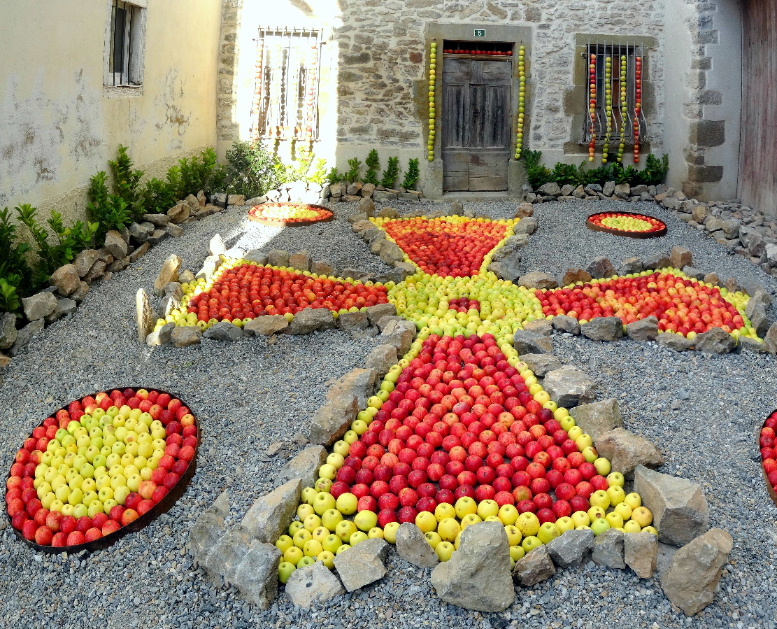
Some houses' courtyards were very elaborately decorated - here the Occitan cross.

... and here a minimalistic but effective approach


9 Oct 2011

An ASHS reunion - à la française


There was an Albany Senior High School reunion last year held in Albany, Western Australia that I wasn’t able to attend. The next best thing was to have two old school friends come and stay – my old friend Susie (the Bulgarian Connection) who was here visiting this time last year – and Di, who I haven’t seen for probably 20 or more years! 


Colour co-ordinated clothes and drinks. But only one of us is grey!

Susie had gone down to meet Di in Istanbul, then spent a few days back in Bulgaria, then onto Barcelona, and then up to me for a week. I was exhausted just hearing about it!

But still enough energy left when they got here for us to have a fabulous time and catch up.

Some of the places we visited, Susie had seen before – but not all of them. So between lots of eating and drinking (no surprises there), reminiscing and many laughs – here’s some of what we got up to.

A good way of seeing a bit of the countryside and the coast around the Etang de Thau (oysters, oysters, and more oysters – and then there’s the mussels….) and the Mediterranean beaches, is to do a loop. Heading east to Pezenas (preferably on a Saturday when there is a great market), Mèze, Bouzigues, Sète and back along the coast via Agde.

That’s a very rough itinerary; it would take days to call into all the places worthy of a visit.

While we were wandering along the waterfront of Sète – France’s biggest fishing port on the Mediterranean
we noticed a tourist boat tied up, and about to leave on a one hour cruise of the coast. We got on at the last minute and went out of the harbour and along the coast a way.

Given that the whole week has had fabulous weather (low 30s - hottest for this time of year since 1985) – it was a great day to get out on the water.

Sète is a lovely town – the huge fishing boats tie up alongside the man-made canals (quays?) that go right into the centre of town – and restaurants and commerce is all around. You can be sitting at a café or restaurant and be metres from giant trawlers, laden with nets – the smell of the sea and fishing boats. 


Another day we took in Narbonne, Gruissan and Gruissan Plage, where all the chalet houses on stilts are to be found. This was the setting for the 80s cult movie Betty Blue. In fact, in the movie she was shown working at the very restaurant we had lunch at – now called Le Grande Soleil


Sitting on the verandah, looking out over Gruissan Plage


What a setting and what a STEAK!  


We were hungry, but not that hungry. Di made a wise choice of seafood. Susie and I decided on meat. It looks big on the plate. It was HUGE. We took rather a lot of it with us when we left - there was enough for rare beef to be used in another meal at home, and then still some left for Nic’s dog!

We called into the old town of Gruissan and climbed the tower in the centre. A fairly windy day, but the climb was certainly worth it - amazing views out over the rooftops and far beyond. 


And on the outskirts of Gruissan are the salt pans and the Gruissan Salt Museum – well worth a visit. 


I hadn't known that there was a little restaurant next to the museum, overlooking the drying salt beds – selling fresh oysters but also with an interesting looking simple menu of the day. Good to keep in mind for another visit another day.

Casual dining at the edge of the salt pans - table tops supported by piles of roof tiles.

We also had a day in Carcassonne and La Cite:


Le Chateau Comptal within the walls of La Cite
Looking over the ramparts, towards 'new' Carcassonne
Close-up of some of the gargoyles on the Basilica of St-Nazaire
Susie and Di - dwarfed by the outer walls of la Cite

And on the last day a trip up into the hills to Minerve. Susie stayed back for a much-needed rest (having visited last year) and Di and I did the walk around the gorges, and through the cave. 


When you emerge from the other end of the cave, you find hundreds of cairns that people have constructed - it's obviously the thing to do, and they make quite a sight. 


Ours was a rather insignificant offering, but hey, we've left our mark!


errr .... that's ours in the foreground .....
'C' for effort

21 Sept 2011

Hallelujah !

The wall is finally finished.


18 months after I started, it’s done. No point in hurrying these things. Actually, as there was no pressing urgency, it’s been very much a stop-start affair. It all depended on the weather forecast, visitors, my levels of energy and enthusiasm, etc.

I’d mix a bucket full of the sand and lime mixture, prepare a section of the wall, plug in my earphones to listen to an audio book and do about a square metre at a time. 


I have to say that seeing the wall being slowly transformed was very rewarding. And though I won’t be hanging my shingle out any time soon, I feel I’ve got a bit of a handle on something else now. The very least 'fun' bit was getting off the concrete rendering - made a little easier when I borrowed a compressor and percussion drill thing. Now that WAS slow work. I wasn’t able to complete the whole project myself – I guess I did about two thirds. It was just too high and I had to get someone in with scaffolding to do the very high bits.

A little recap:

The east wall: BEFORE


The east wall: DURING - and to the height I was able to do


The east wall: AFTER


The west wall: BEFORE

The west wall: AFTER


It did involve draining and moving the fish pond while I did the section of the wall behind.

And while the fish seem happy swimming around in a large rubbish bin - their temporary home for more than a week now - I reckon they’ll be pretty pleased to be back in the pond.


And here’s an aside - and nothing to do with walls. 

Lunch in the nearby village of Ginestas last week with a group of friends. Nic drove, and we had trouble finding a park nearby. We finally found a place, didn’t notice a ‘no parking’ sign (really…) and parked the car.

After lunch, walking back to the car, we noticed fire engines AND police – we heard later that they were trying to get someone from a building, perhaps a stretcher case from an upper floor? There wasn't any smoke or any real sense of urgency thank goodness. Anyway, we stood by, wondering what was going on – this was before noticing the ‘no parking’ sign – and realised we were getting tickets. Well actually, one of our group was.

And here he is (to remain nameless) – hot-footing it down the road. To no avail – a €35 ticket was given out on the spot. Ouch.


Nic and I and Barbara ran to the car just as one policeman was preparing to write a ticket, but we managed to drive away before that happened. Well, we didn't exactly do a runner, we proffered our apologies and said we were just moving (?). 

But not before he pulled out his digital camera and took a photograph of the number plate. 

I think a ticket will be heading to Bize in the post some time very soon….

5 Sept 2011

Domaine Borie de Maurel

I recently went with three friends to the Domaine Borie de Maurel in Felines-Minervois, and enjoyed a great lunch and tasted some delicious wine.


Felines-Minervois – about 25 minutes form Bize-Minervoisis one of the six villages that come under the La Livinière appellation – recognised as the best of the Minervois wines.


And who was our host? - a local Bizoise – the lovely Marie Binisti previously of Les Raisins des Soleil here in Bize. 

She has now moved on to the Domaine Borie de Maurel, sharing her passion and extensive knowledge of the Minervois wines.  


It was just one of those days – temperature mid 20s (not quite spring yet, but it certainly had that feel about it), not a cloud in the sky, a gorgeous drive through the vineyards, excellent wines, food and company. 


It’s not set up as a typical restaurant and there is no set menu. What you get is a plate of delicious tapas-style food – Tapas Occitan – and you get to sit under the shade of an enormous pine tree and gaze over the vineyards towards the Black Mountains.

All of the food is locally sourced, with the fruit and vegetables coming from the Domaine’s own gardens and the unpasteurised Lucque olives from Bize.

Our Tapas Occitan lunch consisted of a plate of olives to start with, toasted bread with tapenade and confit of onions with anchovies, slices of dry cured ham, a bowl of tomatoes,
sliced dried sausage, thinly sliced raw yellow courgettes, braised courgettes  - all in olive oil. And after, a small plate of three different cheeses with sliced figs, and finally a bowl of watermelon and rock melon/cantaloupe – or as it’s known here in France, simply melon.


Food is served only during the summer, and as they are now gearing up for the vendange, we managed to get one of the last lunches of the season. 


The vendange started around here about two weeks ago – very early this year. “The word” is that it’s going to be a very good year ….


We’d done our wine tasting before lunch, so when we were ready to leave we collected our purchases. My favourite was definitely one of the reds - the Belle de Nuit. Divine.

And while I’m looking forward to drinking this, I’m not sure I’ll be cooking tiny wild birds, on a stick (brochette) or otherwise – as suggested on the website write-up:


Accompanying dishes: young, Belle de Nuit goes well with spicy dishes, a beef stew or paella. When it matures it’s time to imagine higher flying dishes such as a song thrush with streaky bacon or a brochette of skylarks.


Marie suggested that it’s best served slightly chilled – definitely not warm. Sounds good to me, and I can’t imagine a thing that it’s not going to go well with!

The courtyard - with its own outdoor chandalier
Kids in a lolly shop....

Look at these hands - what an amazing image .....


Moving sideways

Future posts on Bize-Bytes can now be found on Facebook. Link: https://www.facebook.com/pages/Bize-Bytes/895137113876897